Download Autodesk 3ds Max 2027 (x64) for free, permanent full version. The latest version of the 3D modeling, animation, and rendering software for games, movies, and design work, easy to install.
What is Autodesk 3ds Max?
Autodesk 3ds Max is professional 3D graphics software from Autodesk used for designing models, animation, and realistic image rendering. This program is one of the primary tools for game studios, film production companies, television shows, and design offices worldwide because it allows precise control over 3D details from the initial stage to the final image.
The core of 3ds Max is creating and editing 3D models, starting from basic shapes and building them into characters, vehicles, buildings, furniture, or large environments using Polygon Modeling, Splines, and stacked Modifiers. This workflow allows you to go back and edit shapes, sizes, or details without having to start completely over. Composition tools help distribute duplicate objects across areas or along paths in the scene.
In animation, 3ds Max enables detailed movement control for objects and characters, setting keyframes according to scene timing, controlling motion paths, posing with bones and Rigging systems, and simulating physical behaviors such as cloth, hair, fluids, particles, and object collisions. These animations can be applied to game scenes, cutscenes, commercials, and project presentations.
Another crucial aspect is texturing, lighting, and rendering. The program supports creating materials that mimic wood, metal, glass, stone, and other surfaces, along with lighting and shadowing that closely match reality. Rendering tools like Arnold accurately calculate light, color, and reflections, allowing architects and product designers to visualize buildings or products before actual construction or manufacturing, while game and film creators use these capabilities to build believable atmospheric scenes.
3ds Max also integrates well with other software in the same industry. Files can be exchanged withdesign software, game engines, and editing tools to pass work smoothly between teams, and plugins and scripts can be used to customize workflows for specialized tasks.
Another branch of 3D architectural design uses ArchiCAD to lay out structures and create construction drawings in parallel.
Core Competencies
- Modifier Stack. Non-destructive model editing, stacking modifiers in a sequence and being able to go back to edit any step.
- Modifier stack. A large number of modifiers for shaping, transforming, and refining model details.
- Polygon Modeling. Interactive polygon modeling for characters and precision hard-surface work.
- Smart Extrude. Interactively extrude or cut through polygon faces with automatic stitching of adjacent faces.
- Retopology Tools. Generate clean new quad topology with ReForm from existing mesh data.
- Spline Workflows. Create and edit curves and complex shapes with spline tools
- UV Workflows. Unwrap, edit, and layout UV maps with UVW tools for accurate surface alignment
- Biped. Set up skeletons and animate characters with built-in ready-to-use Biped structures
- Character Animation Toolkit. Create animations and procedural character rigs with CAT
- Motion Paths. Preview and adjust motion paths directly in the viewport
- Animation Controllers. Control all types of animation with easy-to-use controllers
- Fluids. Simulate fluid behaviors such as water, oil, and lava with gravity and collision
- Particle Flow. Generate particle effects like water, fire, spray, and snow
- Material System. Create realistic materials with an OpenPBR-compliant node-based editor
- OpenPBR. Default application materials display consistently compared to other 3D software
- Material Switcher. Switch between multiple material variations of the same model using simple controls
- OSL Support. Use Open Shading Language maps with supported renderers and display accurately in the viewport
- Bake to Texture. Bake PBR and OSL surfaces with scriptable workflows
- Lighting. Set up scene lighting with photometric and standard lights
- Arnold Renderer. Built-in Arnold renderer utilizes GPU to preview lighting, material, and camera changes in real time
- Color Management. Color manage with OCIO to ensure consistent colors across different devices and lighting conditions
- Interactive Viewports. Near-render quality viewport preview for instant visibility of PBR materials and camera effects
- Physical Camera. Simulate real camera settings such as shutter speed, aperture, depth of field, and exposure
- Scene Converter. Convert materials, lights, cameras, and renderers across different suites within the same scene
- OpenUSD. Import and export USD data as native application data, open large scenes quickly, and edit USD layers natively
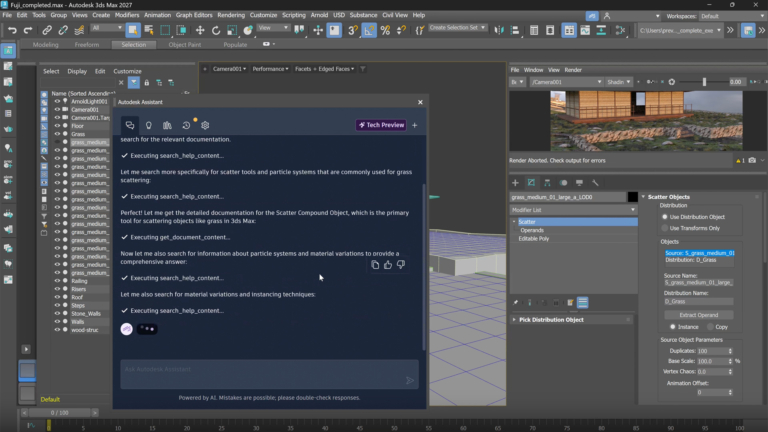
- Autodesk Assistant (Tech Preview). Natural language-driven AI assistant that helps search for data and execute tasks within the scene.
- Modern UI and Workspaces. Self-organizing workspace with a high-resolution display-supported interface.
- Software Security. Safe Scene Script Execution and Malware Removal to scan for malicious scripts in scene files and startup scripts.
- Python 3. Script writing and pipeline connection using Python 3.
- Extensive Plug-in Library. Expand capabilities with third-party developer plugins such as tyFlow, thinkingParticles, and ForestPack.
- glTF Support. Publish assets from scenes as glTF for web apps, online stores, and browser-based games.
- VFX Reference Platform. Compliant with VFX Reference Platform standards for compatibility with other software.
What's new
Improvements in version 2027.3
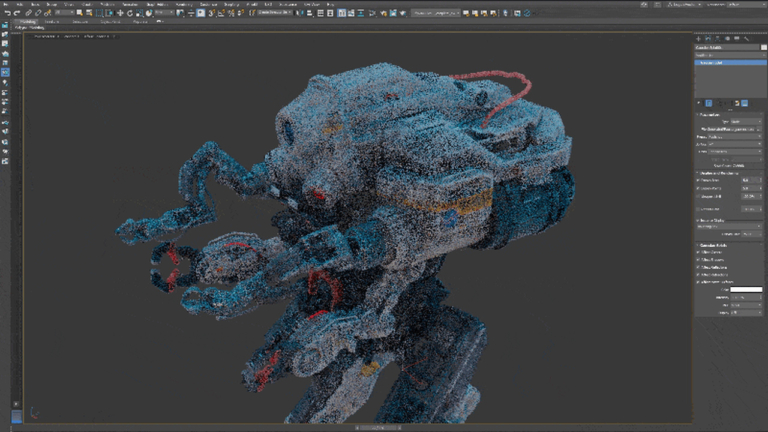
- Gaussian Splat direct viewport rendering via back-to-front sorted splat shaders with colors closely matching final renders, allowing pre-render scene evaluation.
- Support for 4D Gaussian Splat (4DGS) image sequences playable along the timeline, direct loading of PLY and SPZ files from disk, and export of Gaussian Splat to PLY files.
- New point data editing tools including Point Segmentation, Edit Point, Delete Points, and Affect Channel, along with Point Grid and Point from Mesh objects, while Mirror, Slice, and Symmetry are now applicable to points and splats.
- MCP Server (Tech Preview) connecting external AI clients like Claude and Cursor to read and edit scene data upon tool permission approval.
- Autodesk Assistant can now analyze and execute tasks within the scene, upgrading from previous question-only capabilities.
- Arnold for 3ds Max 5.9.5 featuring Arnold Viewport for interactive in-viewport rendering with pause and resume capabilities for production work.
- Built-in Khronos glTF 2.0 importer and exporter, while USD for 3ds Max 0.17.8.1 adds Component Creator and Variant Manager, and Substance 3.1.1 adds OpenPBR support.
System Requirements
- Operating System : Microsoft Windows 11 (64-bit)
- Processor: 64-bit multi-core Intel or AMD processor with SSE4.2 instruction set support.
- Memory: 4 GB minimum (8 GB or more recommended).
- Storage: 9 GB for installation.
- Additional: Autodesk 3ds Max Certified Hardware-listed graphics card and a three-button mouse.
file information
- Operating System: Windows 11 (64-bit)
- Risk Level: Medium
- License: Shareware
- Developer: Autodesk
- Language: Multilingual
- Size: 5.75 GB
- File type : *.rar
- Password: mawto
- Installation method: Yes
- Updated on : 23/11/2026
- Need to read: Download Guide